Young people are making big decisions with limited information.
That is the issue.
They are expected to choose subjects, courses, apprenticeships, university routes and career paths. All this before they have had enough real conversations with people actually working in those industries.
For Antony Grace, Co-Director of ASH Integrated Services, that is exactly why mentoring matters.
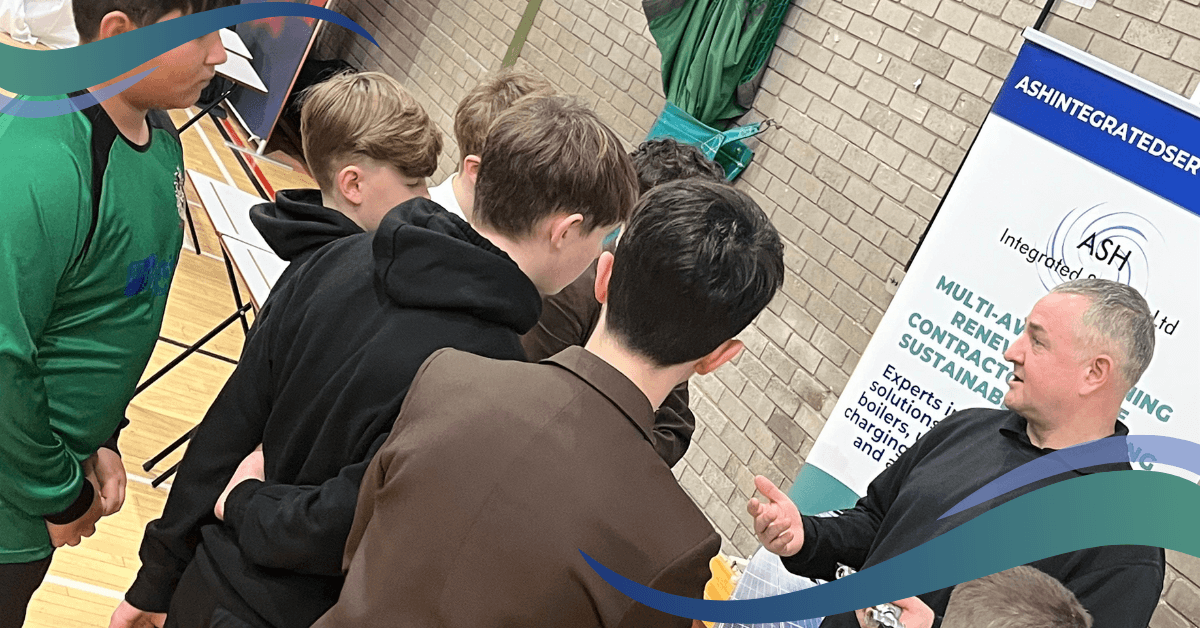
Recently, Antony spent time with students at St John Rigby College. He had one-to-one conversations about careers, confidence, choices and the reality of working in mechanical and electrical engineering.
The Skills Gap Starts Earlier Than Recruitment
Many young people still do not know what opportunities exist within the mechanical and electrical engineering sector.
They don’t realise that engineering can involve technology, sustainability, renewable energy, problem solving, site leadership, apprenticeships, progression and business ownership. They’re surprised to find out that mechanical and electrical engineering sits behind the buildings they use every day, from schools and colleges to hospitals, commercial spaces, housing and public buildings.
That lack of awareness matters, and quite frankly, it’s scary!
The UK is already facing serious skills challenges.
The 2024 employer skills survey found that 27% of vacancies were skill-shortage vacancies, meaning employers struggled to recruit because applicants did not have the right skills, qualifications or experience.
Engineering and technology are also central to the UK economy.
EngineeringUK reports that 6.4 million people work in engineering and technology jobs in the UK, with around a quarter of all job adverts now linked to engineering and technology.
The Industry Is Changing Quickly
Mechanical and electrical engineering is not standing still.
Demand for green skills is rising, with EngineeringUK reporting a 48% increase in job adverts mentioning green skills and a 55% increase in adverts for green engineering jobs.
That matters because the future of our sector will not only depend on replacing the people who retire. It will depend on attracting people who understand new technologies, low-carbon solutions, renewable energy and the changing needs of modern buildings.
If young people do not see that side of the industry, they will never consider it.
Employers Need To Get In The Room
Antony’s view is simple: if employers want better prepared young people, we need to be part of preparing them.
We can’t keep talking about skills shortages while staying out of the rooms where young people are trying to understand their future.
Mentoring gives students the chance to ask questions they might not ask in a classroom. They hear what employers actually look for. What apprenticeships can lead to, what skills matter on site, and what kind of attitude helps people progress.
It also helps challenge outdated views of the sector.
Modern mechanical and electrical engineering is not limited to one type of person, one route or one version of success. It can offer practical, technical, commercial and leadership opportunities. It can suit people who want to work with their hands, solve problems, manage projects, support sustainability or build a long-term career without following a purely academic path.
Why Mentoring Matters
For ASH, this work links directly to the future of the industry.
The business employs apprentices, invests in staff development and understands that the skills pipeline does not begin when someone applies for a job.
It begins much earlier, when a young person starts to understand what is possible.
High-quality careers provision, including meaningful employer encounters, has been linked to better career readiness and a reduced likelihood of young people becoming NEET. The Careers and Enterprise Company has reported that the highest quality careers provision can reduce the likelihood of young people being NEET by 8%.
That supports what employers often see first-hand: when young people meet people from industry, their view of what is possible starts to widen.
A conversation with someone like Antony can help a student ask a better question.
It can make engineering feel more relevant and less out of reach.
For some, it may be the first time they realise there is more than one route into a good career.
That is why showing up matters.
Young people cannot choose careers they do not know exist.